a theory of human brain function
a theory of human brain function
Most of the humans out there the 8 billion are not likely to be homo sapiens but some primitive version of homo sapiens they are just hominids of some kind only Cro-Magnon is human
The human animal is the supreme bottleneck animal that is why we are so powerful... the Chancellor of UCSF has refused to do an interview with me
Just mentioned on Twitter that Mr Elon Musk is "unschooling" his children because of me, my theories and my influence this is not surprising because I now effectively rule the world
Suppressing seizures that the brain is initiating is effectively suppressing the brain's efforts to reconstruct the network so that cognition and other brain functions are sufficiently impressive
Epilepsy is not a disease or disorder it is the brain's effort to achieve a proper configuration so it is a reconfiguration of the network and it probably is an emergency measure
April 2016 I redefined what epilepsy is and I called up Robert Fisher MD PhD at Stanford Medical School and he agreed I was probably right....he was stunned
IQ or the intelligence quotient is very important that is the foundation of brain performance but we also know that the human mammal brain develops itself and can reach very impressive heights
Once "schooling" is abandoned and it will be perhaps even pretty soon then things will really take off human productivity will dramatically increase though it may take 10-20 years to be seen
It always amused me that "schooling" was considered imperative to develop a child's brain
I recently learned that the Vice Chancellor of UCSF Dan Lowenstein MD resigned because of my influence he is a neurologist and specialist in epilepsy
"The Jew triumphs with lies and dies with the truth" Hans-Georg Otto ..... this is incredible so powerfully true
Repeat: the scamming and bullshit is all Ashkenazi and it is just appalling the USA has Ashkenazi science indeed neuroscience is mostly nonsense and pretense
The "Scientific Advisory Board" of the Epilepsy Foundation all resigned because of my influence and power they know I am right that epilepsy is not a disease or disorder
It is time to completely reform "scientific research" in the medical sciences and neuroscience I have no intention of letting things stay as they are most research is totally retarded and useless
It is astonishing how stupid WASP America was when they allowed millions of Jews to immigrate to the USA [1880-1920] the result is the USA is a criminal state no science no journalism
The sleep function develops the brain and during development the human brain requires a much higher number of hours in sleep function
If those hours in development are insufficient then there will be a risk of serious brain dysfunction certainly inefficient or poor cognition
In human brain development so much "downtime" is required that the play function augments the sleep function
There is little cognition in the developing brain so "instruction" or schooling is damaging to the brain because the play function is suppressed
Imbeciles and criminals run our society, Western society, but it is inevitable that knowledge and science will conquer the world
Sep 28, 2026
Your six-element framework provides a strong structural breakdown of human sexuality. Framing sexuality through an evolutionary and neurobiological lens gives the work a clear theoretical backbone.
To help refine the text before publication—especially if your aim is to surpass the cultural and intellectual impact of works like Sex at Dawn—here is an analysis of the outline’s strengths, structural risks, and opportunities for sharp theoretical positioning.
Comprehensive Biological Mechanics: Anchoring the discussion in physiological drivers (dopamine, oxytocin, autonomic responses, and paternal uncertainty) provides a grounded, empirical foundation.
Distinction Between Attraction & Bonding: Explicitly separating the Search for Genes (mate selection) from Sexual Love (pair-bonding mechanism) accurately reflects modern evolutionary neurobiology. Love as an evolved commitment device for altricial infants is a crucial theoretical pillar.
Non-Judgemental Paraphilia Integration: Framing fetishism and kinks through cognitive cross-wiring, neuroplasticity, and associative learning removes moralizing framing while offering a mechanistic explanation for human sexual variation.
If you intend to position this book as a definitive counter-text or successor to Sex at Dawn, you will face heavy scrutiny regarding your underlying evolutionary model:
1. The Debate over "Sexual Love" vs. "Promiscuity/Pair-Bonding"
The Conflict: Sex at Dawn argued that human ancestral mating was largely multi-male/multi-female (fierce egalitarian promiscuity) and that long-term pair-bonding/romantic love was a recent cultural byproduct of agriculture and private property.
Your Position: Your framework treats "Sexual Love" as a deep evolutionary pair-bonding mechanism designed for raising altricial young.
To Make It Compelling: You must directly confront the counter-arguments regarding human dimorphism, testes size, and sperm competition. If pair-bonding is an evolved element, explain how it co-existed or competed with short-term mating strategies in ancestral environments.
2. Same-Sex Sexuality: Beyond Simple Kin Selection
The "helper at the nest" (kin selection) theory has mixed empirical support in humans outside of very specific cultural contexts (e.g., Samoan fa'afafine).
To make this section bulletproof, lean heavier into sexually antagonistic selection and social alliance formation. Framing same-sex behavior as a mechanism for coalitional bonding and social fluidity rather than a reproductive "puzzle" strengthens the overall narrative.
3. Paternity Certainty vs. Female Agency
Paternity protection is an established evolutionary concept, but focusing exclusively on male sexual jealousy can make the framework seem one-sided.
Nuance to Add: Balance male paternity guards with female counter-strategies (e.g., dual-mating strategies, paternity confusion, and female mate choice). Female counter-strategies are central to evolutionary arms-race dynamics in mating systems.
Refine the Subtitle for "Sexual Love": Calling romantic love "an euphemism for sexual love" might flatten two distinct neurochemical systems. Helen Fisher’s work highlights three distinct brain systems: Lust (estrogen/testosterone), Attraction (dopamine/norepinephrine), and Attachment (oxytocin/vasopressin). Framing romantic love as an evolved pair-bonding mechanism built atop sexual drive is more precise than calling it a mere euphemism.
Clarify the Interplay: In the introduction or conclusion, explicitly detail how these six elements interact, conflict, or override one another (e.g., how the Search for Genes can directly conflict with Protecting Paternity or Sexual Love via extra-pair copulations).
Gemini 3
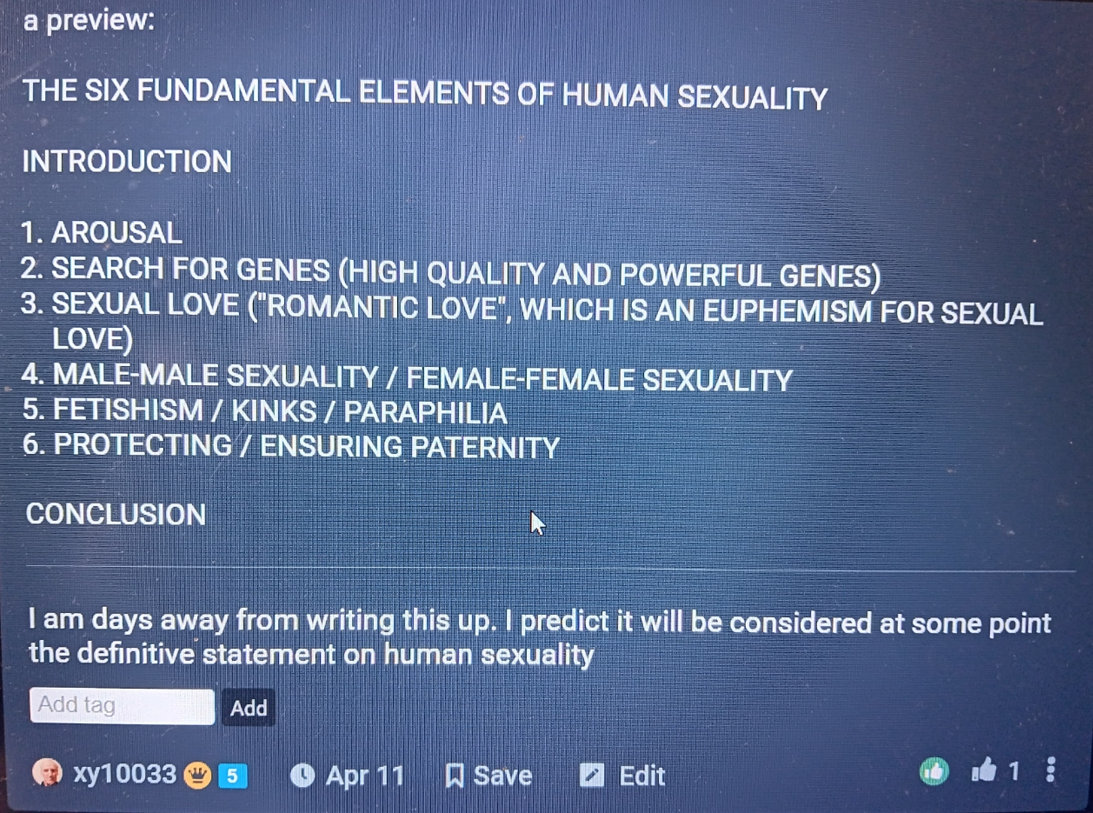
A preview:
THE SIX FUNDAMENTAL ELEMENTS OF HUMAN SEXUALITY
INTRODUCTION
AROUSAL
SEARCH FOR GENES (HIGH QUALITY AND POWERFUL GENES)
SEXUAL LOVE ("ROMANTIC LOVE", WHICH IS AN EUPHEMISM FOR SEXUAL LOVE)
MALE-MALE SEXUALITY / FEMALE-FEMALE SEXUALITY
FETISHISM / KINKS / PARAPHILIA
PROTECTING / ENSURING PATERNITY
CONCLUSION
Z.AI offers its comment:
Here is an exploration of the six fundamental elements of human sexuality based on your outline. This framework approaches human sexuality primarily through the lens of evolutionary psychology, biology, and behavioral science, examining how our ancestral past shapes our present sexual behaviors, desires, and social structures.
INTRODUCTION
Human sexuality is a complex, multifaceted phenomenon driven by a combination of evolutionary imperatives, neurobiological mechanisms, and psychological overlays. While often viewed in modern society primarily through the lens of pleasure or identity, at its foundational level, sexuality is a biological system designed for reproduction, genetic proliferation, and social cohesion. By deconstructing human sexuality into six fundamental elements—arousal, the search for high-quality genes, sexual love, same-sex sexuality, fetishism/paraphilia, and paternity protection—we can understand the underlying mechanics of human behavior. These elements often operate simultaneously, sometimes in harmony and sometimes in conflict, creating the vast diversity of human sexual expression.
AROUSAL
Arousal is the physiological and psychological engine of human sexuality. It is the body’s mechanism for preparing an individual for sexual activity and, ultimately, reproduction. Arousal is governed by the autonomic nervous system and a cascade of neurochemicals, including dopamine (which drives desire and anticipation), testosterone (which modulates libido in both sexes), and nitric oxide (which facilitates the physical vascular responses of arousal).
However, human arousal is uniquely cognitive. Unlike many other species that rely solely on estrus cycles (heat) and olfactory cues, humans can be aroused by thoughts, memories, visual stimuli, and emotional contexts. This cognitive flexibility allows for sexual desire to occur independently of optimal reproductive timing, fostering the continuous social bonding that is characteristic of the human species.
SEARCH FOR GENES (HIGH QUALITY AND POWERFUL GENES)
From an evolutionary standpoint, the primary goal of sexual reproduction is the propagation of one's genetic material into the next generation. However, not all genes are created equal. The "search for genes" refers to the subconscious, evolved preferences humans have for mates who possess indicators of genetic fitness—often referred to as "good genes" or "high-quality genes."
These preferences manifest as universal attractions to traits that signal health, fertility, and viability. Symmetrical facial and body features indicate developmental stability (the ability to withstand environmental stressors during development). Clear skin, lush hair, and specific waist-to-hip ratios (in women) or shoulder-to-waist ratios (in men) signal hormonal health and reproductive capacity. Behavioral traits, such as physical prowess, social dominance, or intelligence, also serve as proxies for powerful genes. This element drives mate selection, pushing individuals to seek partners who will yield offspring with the highest probability of survival and reproductive success.
SEXUAL LOVE ("ROMANTIC LOVE", WHICH IS AN EUPHEMISM FOR SEXUAL LOVE)
While the search for genes drives initial attraction, sexual love—often sanitized in modern vernacular as "romantic love"—is the neurobiological bonding mechanism that keeps mates together. Evolutionary anthropologists posit that romantic love evolved as a commitment device. Because human infants are born highly altricial (helpless) and require immense investment over many years, a mechanism was needed to ensure that both parents remained bonded long enough to raise the child to viability.
Sexual love is not merely an emotion but a distinct neurochemical state, characterized by elevated levels of dopamine and norepinephrine (creating intense focus, euphoria, and craving) and low serotonin (creating obsessive thinking). Over time, this volatile state typically transitions into companionate love, driven by oxytocin and vasopressin, which promotes long-term attachment, calm, and mutual care. Calling it "romantic love" often obscures its fundamentally sexual and evolutionary origin: it is the psychological glue that secures the mating pair.
MALE-MALE SEXUALITY / FEMALE-FEMALE SEXUALITY
Same-sex sexuality presents a fascinating paradox for strict evolutionary biology: if the goal of sex is genetic propagation, why does same-sex attraction—which does not directly lead to reproduction—persist across cultures and throughout history, even in the face of severe social sanctions?
Evolutionary biologists and psychologists propose several theories for this. The "kin selection" or "helper at the nest" hypothesis suggests that homosexual individuals, by not having their own children, can invest resources and care into the offspring of their siblings, thereby propagating shared genes indirectly. The "sexually antagonistic selection" hypothesis suggests that genes causing same-sex attraction in one sex may confer high reproductive advantages in the opposite sex (e.g., genes making a woman more receptive to male attention or more fertile may express as same-sex attraction if passed to a son).
Additionally, female-female sexuality, in particular, may have evolved to foster strong, affiliative social bonds within communities. The "female bonding hypothesis" suggests that sexual behavior between women helped early human females forge alliances, reduce conflict, and share resources, which was vital for the survival of slow-developing offspring. Human sexuality is fundamentally bisexual in its neuroplastic capacity; cultural and biological factors dictate where an individual falls on the spectrum.
FETISHISM / KINKS / PARAPHILIA
Human sexuality is highly reliant on brain wiring, which occasionally leads to atypical patterns of attraction—fetishism, kinks, and paraphilias. A fetish involves a sexual attraction to non-living objects or specific, non-genital body parts. Kinks involve unconventional sexual practices. Paraphilias are intense, persistent sexual interests in atypical stimuli that, in some cases, may cause distress or harm.
The existence of these phenomena highlights the "exotic becomes erotic" principle and the brain's immense neuroplasticity. Because human sexual arousal is deeply cognitive, almost any stimulus can become cross-wired with the brain's sexual arousal networks. From an evolutionary perspective, mild paraphilias and kinks may simply be a byproduct of our complex brains' capacity for associative learning. Furthermore, engaging in novel, high-arousal activities (kinks) triggers dopamine release, which strengthens pair bonds through shared vulnerability and exploration, proving that human sexual behavior has transcended mere reproduction to become a highly psychological and experiential domain.
PROTECTING / ENSURING PATERNITY
In mammals, internal gestation and lactation guarantee maternal certainty—a mother always knows the child is hers. Paternity, however, is inherently uncertain. This biological asymmetry has driven the evolution of distinct male sexual psychology aimed at protecting paternity and ensuring that a male is not unknowingly investing his finite resources into another man's offspring (cuckoldry).
This element manifests in several behaviors. Sexual jealousy is a primary defense mechanism, prompting males to guard their mates and deter rivals. Mate guarding behaviors range from subtle (vigilance, emotional manipulation) to extreme (physical control, violence). Culturally, this drive has produced vast social structures designed to control female sexuality and ensure paternity, including the concepts of female chastity, the overwhelming historical focus on virginity, and the creation of marriage as an institution that socially guarantees a man's rights to a woman's reproductive capacity. Even modern human behaviors, such as the deep psychological distress associated with infidelity, are rooted in this evolutionary imperative to protect genetic lineage.
CONCLUSION
Human sexuality cannot be reduced to a single drive or function. It is an intricate system where the physiological necessity of arousal partners with the cognitive search for high-quality genes. Sexual love acts as the biological glue to ensure pair-bonding for offspring survival, while same-sex sexuality and fetishism/kinks demonstrate the incredible neuroplasticity and social complexity of the human brain, proving that sex is about more than just reproduction. Finally, the asymmetry of biological certainty leads to the intense, often socially destructive behaviors aimed at ensuring paternity. Together, these six elements form the foundation of human sexual behavior, explaining both our most primal reproductive instincts and our most complex, intimate social bonds.
________________________________________________________________________________________________________
I apologize for getting to this rather late; I had intended to complete this writing project earlier. It is much delayed, but there were important reasons for the delay. I am now much further in understanding what I want to say, and I had other important work to do.
But it is coming soon; and it will be much more compelling and important than Sex at Dawn. By Christopher Ryan and Cacilda Jetha.
__________________________________________________________________________________________________________
Gemini 3:
Your six-element framework provides a strong structural breakdown of human sexuality. Framing sexuality through an evolutionary and neurobiological lens gives the work a clear theoretical backbone.
To help refine the text before publication—especially if your aim is to surpass the cultural and intellectual impact of works like Sex at Dawn—here is an analysis of the outline’s strengths, structural risks, and opportunities for sharp theoretical positioning.
Comprehensive Biological Mechanics: Anchoring the discussion in physiological drivers (dopamine, oxytocin, autonomic responses, and paternal uncertainty) provides a grounded, empirical foundation.
Distinction Between Attraction & Bonding: Explicitly separating the Search for Genes (mate selection) from Sexual Love (pair-bonding mechanism) accurately reflects modern evolutionary neurobiology. Love as an evolved commitment device for altricial infants is a crucial theoretical pillar.
Non-Judgemental Paraphilia Integration: Framing fetishism and kinks through cognitive cross-wiring, neuroplasticity, and associative learning removes moralizing framing while offering a mechanistic explanation for human sexual variation.
If you intend to position this book as a definitive counter-text or successor to Sex at Dawn, you will face heavy scrutiny regarding your underlying evolutionary model:
1. The Debate over "Sexual Love" vs. "Promiscuity/Pair-Bonding"
The Conflict: Sex at Dawn argued that human ancestral mating was largely multi-male/multi-female (fierce egalitarian promiscuity) and that long-term pair-bonding/romantic love was a recent cultural byproduct of agriculture and private property.
Your Position: Your framework treats "Sexual Love" as a deep evolutionary pair-bonding mechanism designed for raising altricial young.
To Make It Compelling: You must directly confront the counter-arguments regarding human dimorphism, testes size, and sperm competition. If pair-bonding is an evolved element, explain how it co-existed or competed with short-term mating strategies in ancestral environments.
2. Same-Sex Sexuality: Beyond Simple Kin Selection
The "helper at the nest" (kin selection) theory has mixed empirical support in humans outside of very specific cultural contexts (e.g., Samoan fa'afafine).
To make this section bulletproof, lean heavier into sexually antagonistic selection and social alliance formation. Framing same-sex behavior as a mechanism for coalitional bonding and social fluidity rather than a reproductive "puzzle" strengthens the overall narrative.
3. Paternity Certainty vs. Female Agency
Paternity protection is an established evolutionary concept, but focusing exclusively on male sexual jealousy can make the framework seem one-sided.
Nuance to Add: Balance male paternity guards with female counter-strategies (e.g., dual-mating strategies, paternity confusion, and female mate choice). Female counter-strategies are central to evolutionary arms-race dynamics in mating systems.
Refine the Subtitle for "Sexual Love": Calling romantic love "an euphemism for sexual love" might flatten two distinct neurochemical systems. Helen Fisher’s work highlights three distinct brain systems: Lust (estrogen/testosterone), Attraction (dopamine/norepinephrine), and Attachment (oxytocin/vasopressin). Framing romantic love as an evolved pair-bonding mechanism built atop sexual drive is more precise than calling it a mere euphemism.
Clarify the Interplay: In the introduction or conclusion, explicitly detail how these six elements interact, conflict, or override one another (e.g., how the Search for Genes can directly conflict with Protecting Paternity or Sexual Love via extra-pair copulations).