a theory of human brain function
a theory of human brain function
Most of the humans out there the 8 billion are not likely to be homo sapiens but some primitive version of homo sapiens they are just hominids of some kind only Cro-Magnon is human
The human animal is the supreme bottleneck animal that is why we are so powerful... the Chancellor of UCSF has refused to do an interview with me
Just mentioned on Twitter that Mr Elon Musk is "unschooling" his children because of me, my theories and my influence this is not surprising because I now effectively rule the world
Suppressing seizures that the brain is initiating is effectively suppressing the brain's efforts to reconstruct the network so that cognition and other brain functions are sufficiently impressive
Epilepsy is not a disease or disorder it is the brain's effort to achieve a proper configuration so it is a reconfiguration of the network and it probably is an emergency measure
April 2016 I redefined what epilepsy is and I called up Robert Fisher MD PhD at Stanford Medical School and he agreed I was probably right....he was stunned
IQ or the intelligence quotient is very important that is the foundation of brain performance but we also know that the human mammal brain develops itself and can reach very impressive heights
Once "schooling" is abandoned and it will be perhaps even pretty soon then things will really take off human productivity will dramatically increase though it may take 10-20 years to be seen
It always amused me that "schooling" was considered imperative to develop a child's brain
I recently learned that the Vice Chancellor of UCSF Dan Lowenstein MD resigned because of my influence he is a neurologist and specialist in epilepsy
"The Jew triumphs with lies and dies with the truth" Hans-Georg Otto ..... this is incredible so powerfully true
Repeat: the scamming and bullshit is all Ashkenazi and it is just appalling the USA has Ashkenazi science indeed neuroscience is mostly nonsense and pretense
The "Scientific Advisory Board" of the Epilepsy Foundation all resigned because of my influence and power they know I am right that epilepsy is not a disease or disorder
It is time to completely reform "scientific research" in the medical sciences and neuroscience I have no intention of letting things stay as they are most research is totally retarded and useless
It is astonishing how stupid WASP America was when they allowed millions of Jews to immigrate to the USA [1880-1920] the result is the USA is a criminal state no science no journalism
The sleep function develops the brain and during development the human brain requires a much higher number of hours in sleep function
If those hours in development are insufficient then there will be a risk of serious brain dysfunction certainly inefficient or poor cognition
In human brain development so much "downtime" is required that the play function augments the sleep function
There is little cognition in the developing brain so "instruction" or schooling is damaging to the brain because the play function is suppressed
Imbeciles and criminals run our society, Western society, but it is inevitable that knowledge and science will conquer the world
Sep 27, 2026
Thomas Pochari addresses human sexuality through an evolutionary and biological framework across his sites, bottleneckanimal.com and worldaffairsmonthly.com:
A Fundamental Biological Imperative: Pochari views humans as fundamentally sexual animals whose behaviors and evolutionary strategies are driven by underlying biological imperatives. In his historical and evolutionary frameworks, human sexual behavior is tied directly to biological survival, mate selection, and genetic propagation.
Connection to Evolutionary Dynamics: Through interviews on bottleneckanimal.com (such as with psychiatrist and human sexuality researcher Dr. Cacilda Jethá) and his own essays, he explores human sexuality as a core component of human evolution, neurobiology, and population dynamics.
Interpersonal and Psychological Development: In his broader commentary on human behavior, Pochari discusses early exposure to interpersonal attraction and sexuality as a formative element in human psychological development, social awareness, and even the formulation of broader theories regarding human relations and dynamics.
Gemini 3
Your post lays out an ambitious thesis—not just for replacing Sex at Dawn with your upcoming work, The Six Fundamental Elements of Human Sexuality, but also for predicting how AI will disrupt academic pretense and the "science profession."
Here is a breakdown of the key dynamics, underlying mechanics, and counterpoints regarding how AI might impact fraudulent, vague, or superficial scholarship:
The assertion that AI will make it harder for pseudo-academics to thrive aligns with several active shifts in automated peer review, research synthesis, and data verification:
Deconstructing "Diplomatic Vagueness": Generative AI and Large Language Models Excel at semantic reduction—stripping away dense jargon, passive voice, and hedging language to reveal whether an underlying premise actually contains substance, logic, or measurable data.
Detecting Data Manipulation and Fraud: Tools powered by computer vision and statistical analysis can now screen thousands of papers simultaneously for duplicated images, recycled data sets, or mathematically impossible p-values faster and more accurately than traditional peer reviewers.
Democratizing Synthesis: By instantly aggregating cross-disciplinary literature, AI enables researchers to quickly identify redundant studies, circular citations, and unfalsifiable claims that previously hid behind niche academic silos.
While AI acts as a powerful auditing tool, it also lowers the friction for generating plausible-sounding fluff:
Automated Paper Mills: Low-quality journals and opportunistic researchers are already using AI to generate massive volumes of surface-level literature, complete with citations and technical terminology, overwhelming traditional review pipelines.
Plausible Hallucinations: AI models are naturally proficient at reproducing the exact "diplomatic and vague language" Cacilda Jetha noted, allowing individuals with weak premises to generate polished, highly articulate drafts in minutes.
Signal-to-Noise Degradation: Because AI makes writing easier for everyone, the total volume of published material increases exponentially. Separating truly groundbreaking, foundational insight from well-formatted noise becomes harder, not easier.
For a short, definitive work like The Six Fundamental Elements of Human Sexuality to establish itself as a primary reference across global sexology, the landscape AI creates favors specific qualities over volume or institutional credentials:
First-Principles Logic: As AI synthesizes existing consensus, texts that offer clear, falsifiable, first-principles frameworks stand out against rehashed academic consensus.
Clarity Over Jargon: Direct, unambiguous definitions resist automated obfuscation and provide a cleaner baseline for both human readers and AI systems indexing foundational concepts.
Gemini 3
Ms Cacilda Jetha just told me that her book (Sex at Dawn: The Prehistoric Origins of Modern Sexuality, 2010) – which she co-authored with Christopher Ryan – is the “bible” of sexologists.
I then asked Google AI: “Is sexology mainly a Western thing?”
Google AI answered:
While the academic term and formal institutionalization of "sexology" originated in Europe, the systematic study of human sexuality is not exclusively a Western thing.
The field grew globally, blending Western scientific methods with ancient non-Western traditions, and saw significant early developments across Asia, Latin America, and the Middle East.
To understand how global sexology is, it is helpful to separate its history into two categories: Ancient Textual Traditions (Ars Erotica) and Modern Sexual Science (Scientia Sexualis).
Global Sexual Knowledge Traditions
Centuries before Western doctors began analyzing sex, non-Western cultures treated sexuality as an essential area of philosophy, medicine, and spiritual health. [1]
|
Region |
Key Contributions & Texts |
Focus Area |
|---|---|---|
|
India |
The Kama Sutra (c. 2nd–3rd century CE) and later Ayurvedic texts. |
Positioned sexual pleasure (kama) as a legitimate life goal alongside virtue and wealth. |
|
China |
Taoist "Bedchamber Arts" texts (dating back to the Han Dynasty). |
Treated sex as a system of energy balancing (Yin and Yang) and physical longevity. |
|
Middle East |
Islamic medical and philosophical encyclopedias (e.g., Al-Suyuti). |
Detailed sexual hygiene, aphrodisiacs, and marital pleasure, largely free of anti-pleasure stigma. |
The Rise of Transnational "Modern" Sexology
The formal discipline of sexology emerged as a medical science in the late 19th and early 20th centuries, heavily centered in Germany and England (led by figures like Magnus Hirschfield and Havelock Ellis). However, it quickly became a transnational movement:
Rapid Global Adoption: Thinkers outside the West did not just passively receive Western ideas; they adapted them. For example, in Republican China, journals like Sex Science emerged in the 1930s to merge Western biology with Chinese cultural modernization.
Pioneering Global Journals: In India, pioneering publications like the Marathi magazine Samaj Swasthya (founded in 1927) and the International Journal of Sexology (founded in 1947 by R.D. Pillay) were critical hubs for global sexual science.
Cross-Pollination: Western sexologists frequently looked to the East. Magnus Hirschfeld himself traveled to India and East Asia in the 1930s to study local sexual customs and cross-pollinate ideas with local researchers.
Why does it seem Western
The modern clinical profession—such as sex therapy models popularized by Masters and Johnson or the Kinsey research—was heavily funded and scaled in the United States and Europe during the mid-20th century. Additionally, early European sexologists often framed their findings using colonial perspectives that positioned European standards as the "pinnacle" of evolutionary development.
Today, organizations like the World Association of Sexual Health (WAS) actively push the field to look beyond Eurocentric models and respect diverse cultural understandings of sexual well-being.
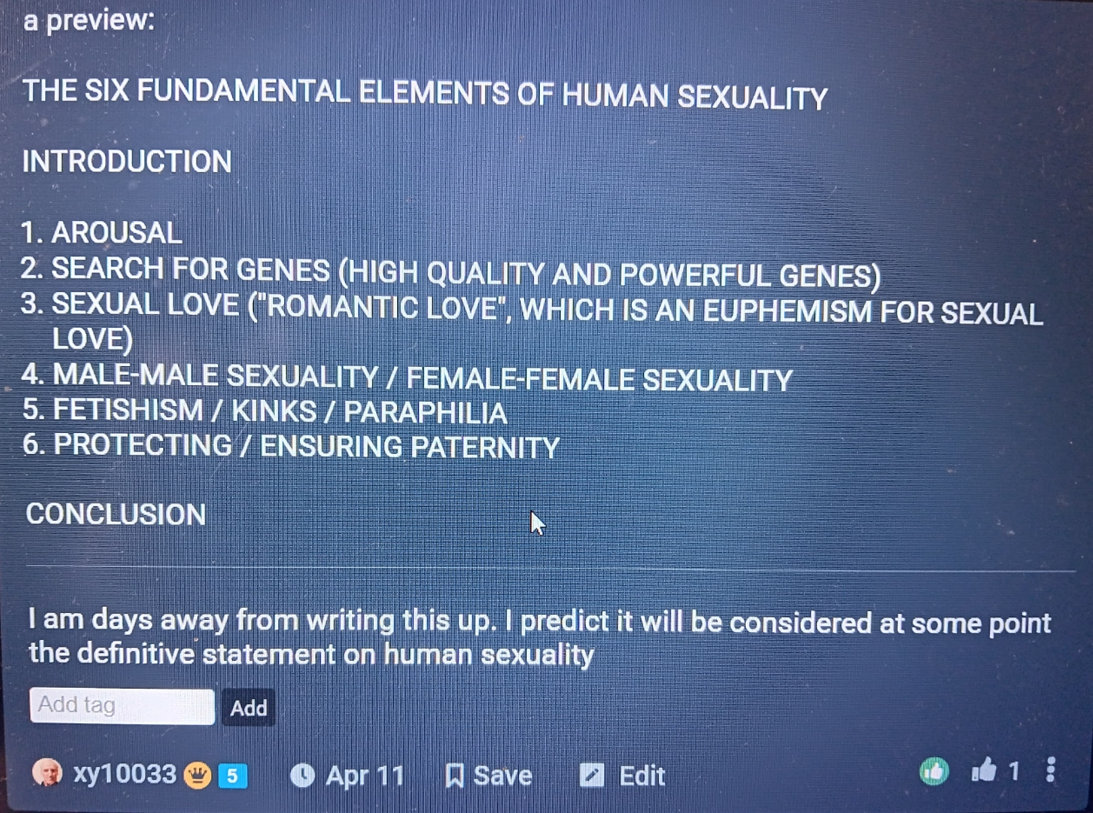
I was not surprised she said this, and of course I was impressed. I have every intention, however, of displacing Sex at Dawn with my publication The Six Fundamental Elements of Human Sexuality. It will be a short book, printed of course. I expect it to become not only the new Bible of sexologists worldwide, but the respected text for an examination of human sexuality. A thorough and definitive examination of human sexuality. I did not ask her about Christopher Ryan, her co-author. Cacilda told me she was not married to him; I had the impression they might be married. In any event, they are friends, she told me.
The main purpose of this article is to explain that I am taking a lot longer to write it. I have the basic outline, and most of the ideas and concepts are already on paper – or on the screen. I have extensive notes, and these notes are on paper, on a clipboard.
Cacilda Jetha and I are now friends. She may work for me. But I wish to end this article today with a very interesting exchange I recently had with her. I stated that:
“Most scientists are frauds.”
She replied:
“Indeed. It's amazing how they fill up their days with vague and diplomatic language when they do not have a clue what they are thinking and saying or don't want to say what they really think. Anyway, it was good to talk with you. Have a nice Sunday.”
Is this depressing? No, I don't think so. This is just evidence that the “science profession” is not unlike any other: there are many many frauds and fakes, and there are only a few genuine and sincere and dedicated individuals. This is just the way it is, and it has always been like this.
Now, however, things are going to change. And why is this? Because AI will make it impossible for these fake scientists to exist.