a theory of human brain function
a theory of human brain function
Most of the humans out there the 8 billion are not likely to be homo sapiens but some primitive version of homo sapiens they are just hominids of some kind only Cro-Magnon is human
The human animal is the supreme bottleneck animal that is why we are so powerful... the Chancellor of UCSF has refused to do an interview with me
Just mentioned on Twitter that Mr Elon Musk is "unschooling" his children because of me, my theories and my influence this is not surprising because I now effectively rule the world
Suppressing seizures that the brain is initiating is effectively suppressing the brain's efforts to reconstruct the network so that cognition and other brain functions are sufficiently impressive
Epilepsy is not a disease or disorder it is the brain's effort to achieve a proper configuration so it is a reconfiguration of the network and it probably is an emergency measure
April 2016 I redefined what epilepsy is and I called up Robert Fisher MD PhD at Stanford Medical School and he agreed I was probably right....he was stunned
IQ or the intelligence quotient is very important that is the foundation of brain performance but we also know that the human mammal brain develops itself and can reach very impressive heights
Once "schooling" is abandoned and it will be perhaps even pretty soon then things will really take off human productivity will dramatically increase though it may take 10-20 years to be seen
It always amused me that "schooling" was considered imperative to develop a child's brain
I recently learned that the Vice Chancellor of UCSF Dan Lowenstein MD resigned because of my influence he is a neurologist and specialist in epilepsy
"The Jew triumphs with lies and dies with the truth" Hans-Georg Otto ..... this is incredible so powerfully true
Repeat: the scamming and bullshit is all Ashkenazi and it is just appalling the USA has Ashkenazi science indeed neuroscience is mostly nonsense and pretense
The "Scientific Advisory Board" of the Epilepsy Foundation all resigned because of my influence and power they know I am right that epilepsy is not a disease or disorder
It is time to completely reform "scientific research" in the medical sciences and neuroscience I have no intention of letting things stay as they are most research is totally retarded and useless
It is astonishing how stupid WASP America was when they allowed millions of Jews to immigrate to the USA [1880-1920] the result is the USA is a criminal state no science no journalism
The sleep function develops the brain and during development the human brain requires a much higher number of hours in sleep function
If those hours in development are insufficient then there will be a risk of serious brain dysfunction certainly inefficient or poor cognition
In human brain development so much "downtime" is required that the play function augments the sleep function
There is little cognition in the developing brain so "instruction" or schooling is damaging to the brain because the play function is suppressed
Imbeciles and criminals run our society, Western society, but it is inevitable that knowledge and science will conquer the world
Sep 29, 2026
I have been very busy for the past few months – everyone knows that. I look back on the past 20 years ago, and I am sometimes not surprised at all that only now, at age 68, do I really kick ass. I mean, what is happening now is almost bordering on the insane. I would have never imagined myself taking over the world. Or would I have?
Actually, when I was a teenager I know that these things would happen. I knew what my trajectory was – what it would be. About one month ago I got a text from a woman, and immediately she sent me a photo of her. She was extraordinarily beautiful. So, I was naturally a bit suspicious, but the we texted a little I could tell that this was a genuine outreach. She was real. She said she was 29. She clearly was interested in me. So, we texted for several hours. Then it was a just an accident that I found out who she was.
Why do I tell this story? Because this is a new world. She found me on the net. She understood everything about me. She has obviously a lot of trouble finding a man. She is famous and wealthy. And she is, as I said, extraordinarily beautiful. Ever since I told her I knew who she was, she has almost disappeared. It is as if once I knew who she was, she was uncomfortable. She did not want me to want her for her wealth. At least, it seems that way.
We are in Phase 3 of human history. We are in the transition to Phase 3. Everything is going to change. Will this woman and I become a couple? Probably. Everything is now known. There are mysteries, but as time passes there will be fewer and fewer mysteries. I copied and pasted in both Google AI and Z.AI the table of contents of my forthcoming article on human sexuality.
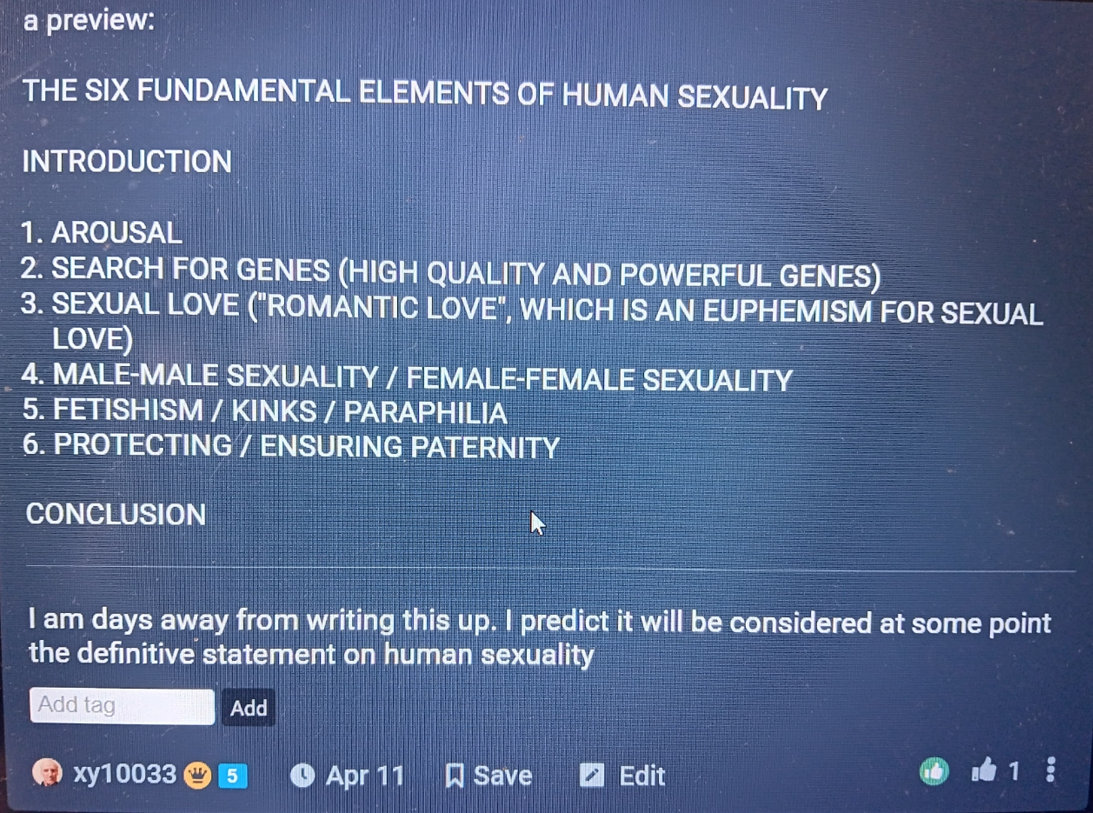
The table of contents is here:
THE SIX FUNDAMENTAL ELEMENTS OF HUMAN SEXUALITY
INTRODUCTION
1. AROUSAL
2. SEARCH FOR GENES (HIGH QUALITY AND POWERFUL GENES)
3. SEXUAL LOVE ("ROMANTIC LOVE", WHICH IS AN EUPHEMISM FOR SEXUAL LOVE)
4. MALE-MALE SEXUALITY / FEMALE-FEMALE SEXUALITY
5. FETISHISM / KINKS / PARAPHILIA
6. PROTECTING / ENSURING PATERNITY
CONCLUSION
Google's Gemini 3:
Human sexuality is a complex interplay of evolutionary biology, neurochemistry, psychological drives, and socio-cultural structures. While often culturally framed through emotional, social, or spiritual lenses, its core mechanisms are fundamentally driven by reproductive strategy, genetic preservation, and social cohesion. Frameworks analyzing sexuality through evolutionary psychology categorize human sexual behavior into distinct functional pillars. These six elements address how humans select partners, establish bonds, navigate biological investments, and express sexual variation.
Arousal is the physiological and neurobiological activation system that prepares the body for sexual behavior and motivates mate-seeking activity.
Neurochemical Cascades: Sexual arousal is primarily mediated by dopamine (motivational drive and reward anticipation), norepinephrine (alertness and physiological readiness), and oxytocin/vasopressin (tactile sensitivity and bonding).
Physiological Response: Controlled by the autonomic nervous system, sexual excitement triggers vasocongestion (increased blood flow to erectile tissue), muscle tension, elevated heart rate, and heightened sensory awareness.
Sensory and Cognitive Triggers: Arousal operates via central activation (visual, tactile, auditory, or olfactory stimuli) and cognitive processing (fantasy, contextual cues, and psychological safety or novelty).
Adaptive Function: It serves as the immediate biological engine ensuring that individuals act upon reproductive opportunities when contextually appropriate visual or behavioral cues are detected.
Sexual selection theory posits that mate choice is driven by the subconscious evaluation of genetic fitness and resource access.
Intersexual Selection (Female Mate Choice): Because women incur higher parental investment (gestation, lactation), evolutionary models suggest a preference for cues indicating resource potential, social status, physical protection, and genetic health (e.g., facial symmetry, clear skin, height, and muscularity).
Intrasexual Competition (Male Selection Strategies): Males typically prioritize indicators of peak youth and reproductive capacity (e.g., specific waist-to-hip ratios, skin tone, clear features), driving competition among males for access to high-fertility partners.
The "Good Genes" Hypothesis: Preferences for specific physical traits, scent signals (Major Histocompatibility Complex / MHC diversity), and behavioral displays of competence serve as proxy indicators for immunocompetence, longevity, and overall genetic robustness.
What is popularly termed "romantic love" functions biologically as a specialized neurological mechanism designed to facilitate long-term pair bonding.
Evolutionary Purpose: Human infants require extensive, multi-year parental investment to reach independence. "Romantic love" functions as an attachment mechanism that holds two individuals together long enough to co-parent offspring through their most vulnerable stages.
Neurological Phases:
Lust: Driven by testosterone and estrogen, focusing on sexual desire.
Attraction: Driven by dopamine, serotonin, and norepinephrine, producing intense focus, obsessive thinking, and euphoria regarding a specific partner.
Attachment: Driven by oxytocin and vasopressin, transitioning intense passion into long-term feelings of security, trust, and mutual commitment.
Euphemistic Function: Framing sexual pair-bonding as an abstract or transcendent emotion ("romantic love") serves a socio-cultural function, reinforcing social norms, monogamous commitments, and family structures that stabilize child-rearing environments.
Same-sex sexual behaviors and attractions exist across cultures and throughout human history, representing a key aspect of human sexual diversity.
Evolutionary Perspectives: Several models explain the persistence of same-sex attraction in evolutionary terms:
Kin Selection Hypothesis: Non-reproducing individuals increase their inclusive fitness by contributing resources and protection to genetic relatives (nieces, nephews, siblings), helping pass on shared genes.
Social Cohesion and Alliance Formation: Same-sex bonding reduces intrasexual conflict, fosters cooperative coalitions, and secures resource sharing within groups.
Balanced Polymorphism / Antagonistic Pleiotropy: Genes associated with same-sex attraction in one sex may confer high reproductive success or increased fecundity when expressed in the opposite sex.
Fluidity and Dimorphism: Female sexual orientation often exhibits higher levels of fluidity across the lifespan compared to male sexual orientation, reflecting different evolutionary constraints and social dynamics.
Human sexual response exhibits a wide spectrum of visual, tactile, and psychological conditioning that extends beyond standard copulatory contexts.
Neuro-Associative Conditioning: Sexual interest can become linked to non-genital body parts, specific objects, or novel scenarios through early developmental associations, unexpected high-dopamine experiences, or sensory cross-activation in the brain.
Novelty and Risk Processing: Kinks and paraphilias often engage the brain's threat and adrenaline systems (e.g., power dynamics, sensory deprivation, risk-taking), utilizing intense non-sexual physiological states to amplify sexual excitement.
Spectrum of Expression:
Non-Clinical Variants (Kinks/Fetishes): BDSM, specific garment preferences, or non-traditional sexual scenarios that do not cause distress or impairment.
Clinical Paraphilic Disorders: Cases where specific fixation is required for sexual arousal and causes intense psychological distress, impairment, or harm to self or others.
In species with internal fertilization where males invest heavily in offspring, "paternity uncertainty" acts as a major evolutionary pressure, driving specific behavioral and physiological adaptations.
Mate Guarding Behavior: Evolutionary strategies to prevent extra-pair copulations include territoriality, emotional possessiveness, sexual jealousy, and social monitoring of partners.
Sperm Competition: Physiological adaptations (such as sperm morphology, seminal fluid chemistry, and ejaculate volume adjustments based on perceived risk) operate at a biological level to maximize reproductive success when multiple partners may be present.
Psychological and Cultural Mechanisms: Cues of fidelity, emphasis on chastity in specific socio-historical contexts, and emotional reactions to sexual versus emotional infidelity reflect evolutionary adaptations designed to minimize non-paternal resource allocation.
Human sexuality cannot be understood through any single biological or socio-cultural lens alone. It operates as an integrated system where evolutionary drives—ranging from gene selection and paternity assurance to same-sex alliance and pair bonding—interact continuously with neurochemistry and individual psychology. Recognizing these core mechanisms offers a clearer framework for understanding the full diversity of human sexual behavior, relationship structures, and romantic expressions.
Z.AI:
THE SIX FUNDAMENTAL ELEMENTS OF HUMAN SEXUALITY
INTRODUCTION
Human sexuality is one of the most complex, multifaceted, and misunderstood aspects of the human experience. It is not merely a biological drive for reproduction, nor is it solely a product of cultural conditioning. Rather, human sexuality sits at the intersection of evolutionary biology, neurochemistry, psychology, and sociology. To understand why humans behave the way they do in the sexual realm—why we desire, why we love, why we deviate, and why we compete—we must deconstruct sexuality into its core components. While human sexual expression is infinitely varied, it is driven by six fundamental elements that have been shaped over hundreds of thousands of years of evolutionary history. These elements are: Arousal, the Search for Genes, Sexual Love, Same-Sex Sexuality, Fetishism/Kinks/Paraphilia, and Protecting/Ensuring Paternity. Together, they form the architecture of human desire.
1. AROUSAL
Arousal is the engine of human sexuality. It is the physiological and psychological state that prepares the body for sexual activity. From an evolutionary standpoint, arousal is a motivational state, driving the individual away from other survival tasks and toward reproductive opportunity.
Biologically, arousal is governed by the endocrine system and the central nervous system. Hormones like testosterone act as the basal fuel for desire in both men and women, while neurotransmitters like dopamine mediate the anticipation and craving for sexual gratification. However, human arousal is uniquely psychological. Unlike other animals that rely solely on olfactory cues (estrus or "heat"), humans are visual and cognitive creatures. Arousal can be triggered by a sight, a memory, a fantasy, or an emotional connection.
Psychologists often refer to the "dual control model" of sexual arousal, which posits that humans have a sexual "accelerator" (responding to relevant sexual stimuli) and sexual "brakes" (responding to threats, anxiety, or repulsion). The interplay of these accelerators and brakes explains the vast individual variation in human libido and sexual responsiveness.
2. SEARCH FOR GENES (HIGH QUALITY AND POWERFUL GENES)
While arousal provides the motivation to mate, the Search for Genes dictates the target of that motivation. Evolutionary biology reveals that human mating is rarely random; it is a subconscious audition for genetic fitness. The ultimate goal of any organism is to propagate its genes into the next generation, and the best way to do this is by combining them with high-quality, powerful genes that offer survival advantages to offspring.
This drive manifests in universal human preferences. We are drawn to markers of genetic health, youth, and fertility: facial and bodily symmetry (indicating developmental stability), clear skin, and specific waist-to-hip ratios. However, "powerful genes" are not solely physical. In the human species, where survival is heavily reliant on social intelligence and cooperative strength, genetic quality also encompasses intelligence, social status, resource acquisition potential, and emotional stability. The intense human focus on status, wealth, and physical prowess in mate selection is not a modern superficiality; it is an ancient, hardwired algorithm for securing the best possible genetic legacy.
3. SEXUAL LOVE ("ROMANTIC LOVE", WHICH IS AN EUPHEMISM FOR SEXUAL LOVE)
Society often elevates "romantic love" as a pure, ethereal, and non-biological force. In reality, what we call romantic love is a euphemism for sexual love—a neurochemical cocktail designed by evolution to ensure successful reproduction and offspring survival.
Anthropologist Helen Fisher divides sexual love into three interlocking brain systems, each with a distinct evolutionary purpose:
Lust: The craving for sexual gratification, driven by testosterone, aimed at finding a range of viable mate
Attraction (Infatuation): The obsessive, focused pursuit of a specific individual, driven by high levels of dopamine and norepinephrine. This phase ensures mating energy is not wasted on unsuitable partners
Attachment: The deep sense of calm, security, and bonding with a long-term partner, driven by oxytocin and vasopressin. This phase evolved to keep parents together long enough to raise highly vulnerable human infants
Calling it "romantic love" allows humans to culturally sanitize the raw, biological imperative of sexual bonding. Yet, its roots are deeply sexual. The intense desire to merge1 merge with another person, the jealousy felt toward rivals, and the profound grief of a breakup are all evolutionary mechanisms ensuring that the sexual bond—and the genetic investment: remains unbroken.
4. MALE-MALE SEXUALITY / FEMALE-FEMALE SEXUALITY
Same-sex sexuality presents an apparent paradox to evolutionary theory: if the goal of sexuality is reproduction, suggests that same-sex attracted individuals, by not producing their own offspring, can invest resources and care into the offspring of their siblings, thereby passing on shared genetic material. The "sexually antagonistic selection" hypothesis suggests that genes promoting same-sex attraction in one sex may increase reproductive success in the opposite sex (e.g., genes that make men more attracted to men might also make their female relatives more fertile).
Furthermore, same-sex sexuality may have evolved as a mechanism for social bonding and alliance formation. In humans, sexuality is not just about procreation; it is about affiliation. Female-female sexuality, for instance, often exhibits greater fluidity than male-male sexuality, suggesting different evolutionary pathways. Female sexual fluidity may have historically been adaptive in polygynous environments where women shared mates and needed strong intra-female bonds to co-parent and survive. Regardless of the specific evolutionary pathway, same-sex sexuality is a natural, enduring variant of human sexual expression.
5. FETISHISM / KINKS / PARAPHILIA
If the previous elements represent the "standard" evolutionary playbook, fetishism, kinks, and paraphilias represent the human brain's extraordinary capacity for sexual innovation and detours. A fetish involves sexual arousal to non-living objects or non-genital body parts; kinks involve unconventional sexual practices; and paraphilias are intense sexual interests in atypical targets or situations.
From a neurological standpoint, fetishes likely arise from the brain's "cross-wiring." The somatosensory cortex processes sensory inputs, and the regions processing genitalia and feet, for example, are adjacent. Neural spill: spill-over between these regions may explain the prevalence of foot fetishism. Psychologically, paraphilias often result from classical conditioning during early sexual development, where a neutral object becomes permanently associated or paired with early sexual arousal.
Evolutionarily, the human propensity for kinks and fetishes may be an example of "sexual selection running wild." Once human cognition became complex enough create abstract desire from the purely reproductive act, sex became a playground for cognitive exploration. Power dynamics (dominance and submission), pain (masochism), and novel scenarios (voyeurism) exploit the brain's reward systems, intensifying dopamine releases. While some paraphilias can cause distress or harm (and are classified as disorders), the vast spectrum of human kinks demonstrates that human sexuality is driven as much by psychological curiosity and the pursuit of neurological reward as it is by biological reproduction.
6. PROTECTING / ENSURING PATERNITY
For a female, ensuring parentage is biologically guaranteed: she gives birth to the child, so she knows the child shares her genes. For a male, paternity is inherently uncertain. This "paternity uncertainty" has profoundly shaped human sexuality, society, and male psychology. If a male invests resources, time, and protection into a child that is not his, he suffers a massive evolutionary fitness loss—he has been cuckolded.
Consequently, a vast array of human sexual behaviors and cultural institutions are designed around protecting and ensuring paternity. Male sexual jealousy is one of the most dangerous and consistent cross-cultural phenomena, often leading to mate-guarding behaviors, controlling female sexuality, and violence. Culturally, the intense historical focus on female virginity, chastity belts, modesty dress codes, and the harsh punishment of female adultery all stem from male strategies to ensure paternity.
Conversely, females have evolved counter-strategies. Because human infants require immense investment, women often seek a mate who will provide and protect (ensuring paternity certainty for the male), while occasionally seeking extra-pair copulations with men of higher genetic quality (the "sexy son" hypothesis). This evolutionary arms race between male certainty and female choice drives much of the complexity, deception, and drama in human sexual dynamics.
CONCLUSION
Human sexuality is not a single drive, but a symphony of interacting forces. Arousal provides the energy, the search for genes provides the target, and sexual love binds the partners together for the arduous task of child-rearing. Same-sex sexuality provides vital social bonding and inclusive fitness benefits that enrich the human community. Fetishism and kinks showcase the human mind's ability to decouple sex from reproduction in pursuit of pure cognitive reward. Finally, the drive to protect and ensure paternity creates the intense competition, jealousy, and social architecture that surround the sexual act.
To look at human sexuality through these six elements is to recognize that we are not merely cultural beings acting out social scripts, nor are we simply animals ruled by instinct. We are a profoundly complex species, carrying the legacy of millions of years of evolution in our desires, our fears, and our loves.
________________________________________________________________________________________________________
This is quite extraordinary, no? I will offer my comment later, I am tired and must sleep. The world is going to change. We are in Phase 3 of human history. There is no doubt. What seems to be true is that my table of contents is brilliant -- and AI runs with this briliance. See what I am suggesting? It is a collaboration. It will be a collaboration -- an utterly brilliant collaboration, a stunning collaboration.
This seems to be our future. Fake scientists are finished. Fraudulent science is finished.